Thank you for the letters with the answers to the linear tracker versus pivoting tonearm puzzle in the previous blog post! This is probably the most letters I have ever received following a blog post, not counting the hate mail after our “compliance matching” series.
Curiously, practically every single person got the answer wrong! Here’s the correct legend:
Red is a linear tracker. Blue is TA-SF9R.
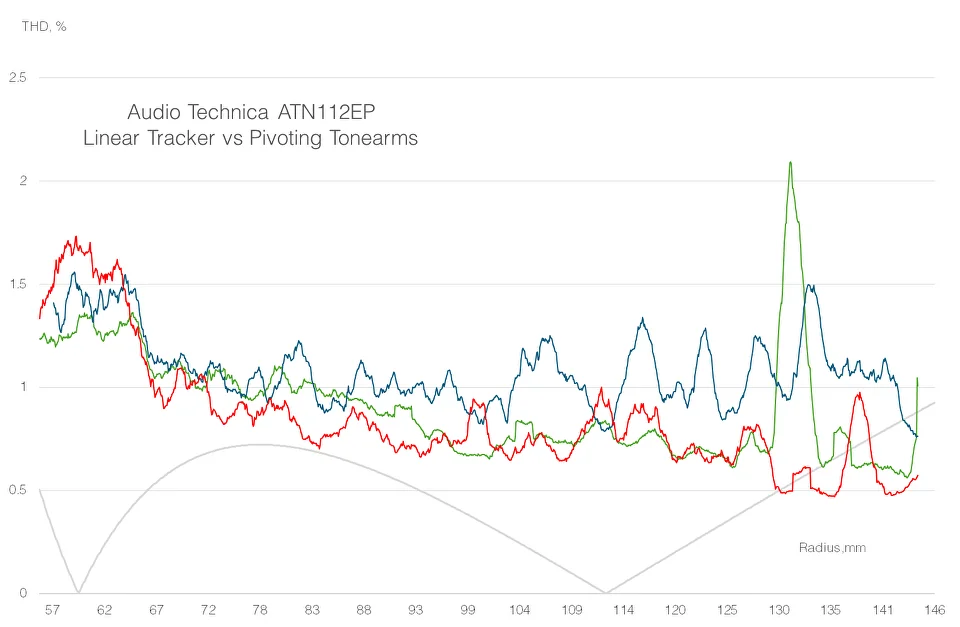
For the linear tracker, the TDH is rising as a function of linear groove speed. And for the 9″ pivoting arm, there’s something that keeps the THD higher up until the last few centimeters of LP’s radius. What can that be?
There’s a green line on the chart that may help us solve this riddle. It’s also a pivoting tonearm, our own TA-SF11R. And it’s THD chart is uncannily close to the linear tracker’s.
What is going on here?
We have already established that the tracking error is not the whole explanation. Otherwise the THD would have converged at null points. There is something else at play here, and I want to know what it is.
Offset Angle and THD
There is a school of thought that believes that the torsional force on the cantilever plays a large role. Introduce an offset angle, and you are introducing a large variable torque trying to rotate the cantilever along its longitudinal axis (in azimuth).
Many years ago, we built a rig to test whether this is true. We glued a speck of foil to the cantilever, pointed a laser at it, and filmed its reflection on a screen. If the cantilever did dynamically rotate in azimuth, the reflection will be jumping up and down.
All this was easier said than done, and the experiment proved to be extremely fiddly. It took us a week instead of a few hours to get unambiguous results. And yes, we established that the cantilever does rotate in azimuth dynamically, and the extent of its rotation is influenced by the offset angle. Unfortunately I can’t show you any pretty pictures. This was back in the 1990s — the state of the art data capture was a VHS camera, and some tracing paper laid over the TV screen.
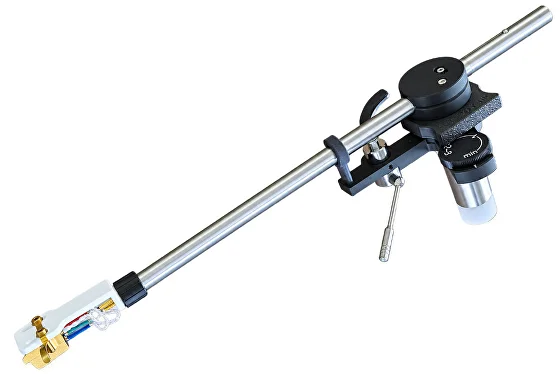
We have much better tools now. Also, very conveniently, I have a company that builds tonearms. Why don’t we make a zero offset angle tonearm, and see what the THD curve would look like?
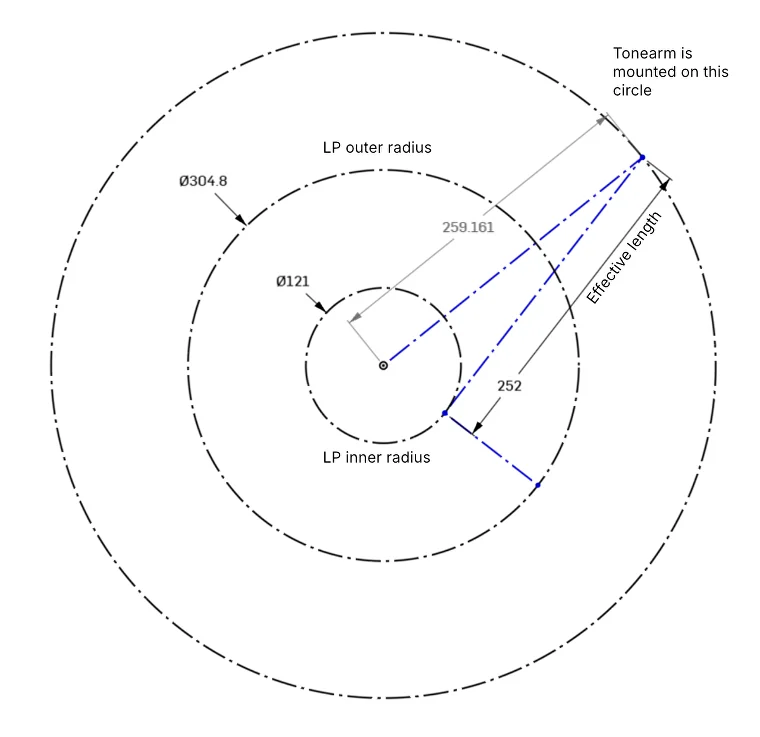
Here’s the arm we built. It is based on our own TA-SF9. Adding a removable headshell lengthens it considerably, to 252 mm effective length. We positioned it so that the tracking error is zeroed at the inner grooves, and that gave us a pivot to spindle distance of 259 mm.
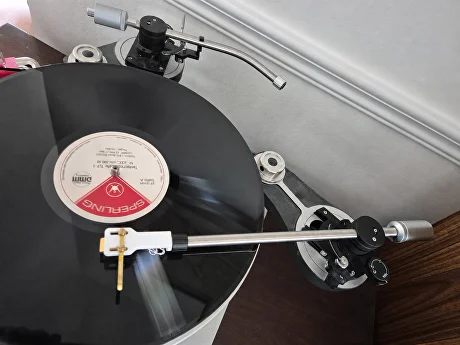
Then we mounted the same cartridge, and ran a THD measurement of the same test LP. The results are below.
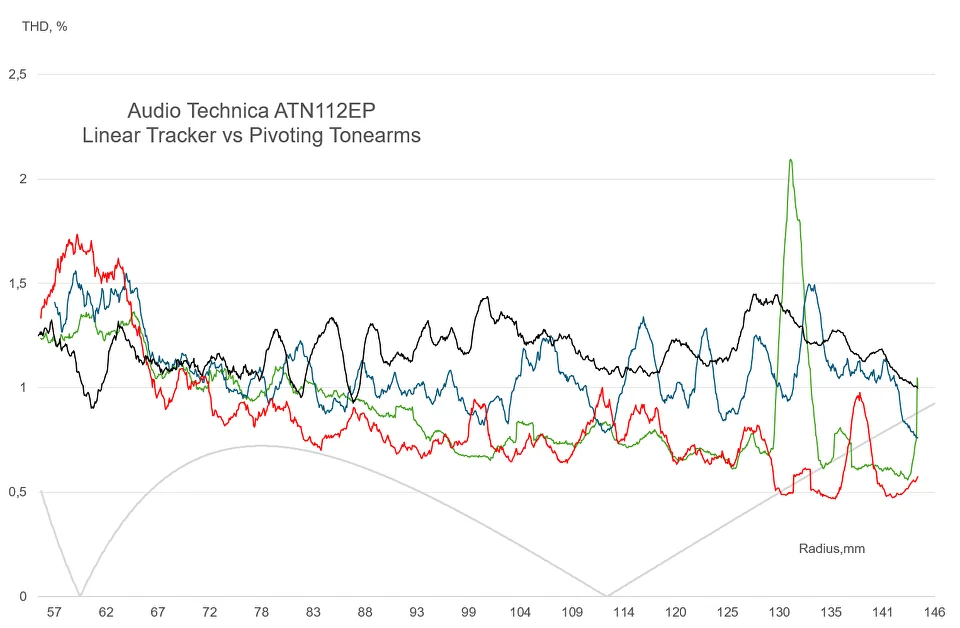
Black is our new straight, zero offset tonearm. To remind you, red is a linear tracker, blue is TA-SF9R (9″), green is TA-SF11R (11″).
And it is comfortably the worst of all four. Given that it’s quite a bit longer than our 9″ arm (252 vs 229 mm effective length, 23 mm more), I fully expected it to perform at least as well. Well, I was wrong.
If the offset angle and the resulting azimuth torque significantly contributed to distortion, then we’ll see a clear hierarchy of distortion in the inner grooves: linear tracker and the zero offset arm first, then the 11″, and the 9″ would be last. This is not what we observe.
These experiments leave us in a strange situation. On one hand, we have clearly shown that established alignments such as Baerwald or Löfgren are not supported by measurements. On the other hand, there is a clear distortion benefit from lower tracking error. Looks like this benefit disappears completely at smaller error angles, and it is heavily dependent on the linear groove speed (as expected). It also seems to rise quickly past a certain error angle. This is a common theme with most stylus/cartridge adjustments that we have explored.
It feels prudent to attack this problem and try and derive an empirically supported error angle to distortion relationship. Seems like a noble challenge.
Unfortunately, it’s the one for which I am ill equipped at the moment. Running a company takes a lot of time and mental bandwidth. So I will probably leave it at this, making a mental bookmark to come back when (if) I have more time.