Superfan Alec Peters wanted to make his own Star Trek movie. What could possibly go wrong?
In the 21st century…
It is with a heavy heart that I report on a drama so psychologically dense and labyrinthine that it might have confounded Shakespeare. In another life it might have provided writers with inspiration and dialogue for a highbrow Star Trek episode, but we don’t live in that world anymore, and it’s no use fans trying to circumvent the imbecilic custodians of Gene Rodenberry’s universe and make something worthy of the bard either, because one man has ensured the genre literate Trekkie will forever be the Bridesmaid of Chaotica and never the bride. His name is Alec Peters.
Peters’ story begins in the first half of the last decade. The Star Trek fan and one-time lawyer, who might have trained at the Lionel Hutz Academy for Lawyering (lawyers should never be Star Trek fans, as they have no imagination – that’s why they’re lawyers) had a dream – to independently produce a prequel to the 1966-69 TV series that, like most prequels, would expand on a single line of dialogue from an obscure episode – in this case “Whom Gods Destroy” (incidentally, a warning about hubris) and backfill the story of Garth of Izar, a legendary Starfleet captain (so a role for a modest man) who won a decisive victory over the Klingon Empire – the battle of Axanar. When writer Lee Erwin penned the instalment, he couldn’t have dreamed that his throwaway bit of worldbuilding would one day amplify a fan’s megalomania and lead to a legal and propaganda battle that would activate the self-destruct of the good ship Ambition, spread the debris across decades, kill friendships, cost millions, split a community, and frustrate the fan fic follies of Trekkies worldwide.
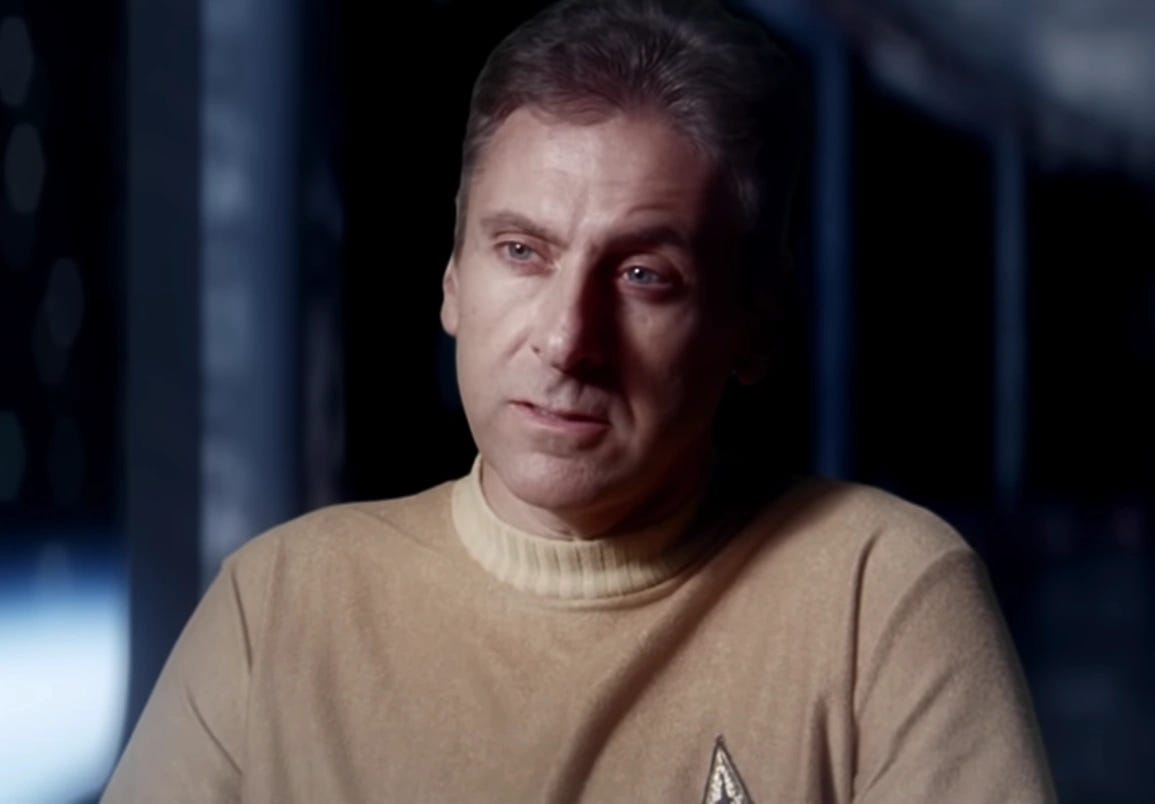
Peters was a successful entrepreneur who’d made money as an auctioneer, a career that overlapped with the world of Star Trek when his company Propworx won a contract to sell off franchise memorabilia. Auctioneering however, could not contain a man who looked to the stars and saw his name in the firmament. Unlike many Trekkies, he was in a position, liminal to Hollywood, to both make his dreams of acting and producing so and recruit Trek-adjacent talent on both sides of the camera. In 2013, he convinced Free Enterprise director Robert Meyer Burnett, a superfan who’d directed none other than Tekwar author William Shatner, and genre luminaries like Tony Todd and Richard Hatch, to help gestate Prelude to Axanar, a proof-of-concept short, in the faux documentary style, that would set up the main event – a low budget feature-length lore expanding insert and reverential franchise extension, that would feed hungry fans who, since 2009, had been fed rice soup and bread in the form of JJ Abrams’ imbecilic Kelvin-verse movies.
I remember seeing Prelude and feeling like I’d taken a pure shot of Star Trek to the dick. Intelligently written, well-made and canonically congruous, it was the kind of high-minded franchise treatment that fans had craved since the premature death of Enterprise (2001-05). Inadvertently, it laid down the gauntlet to Alec Kurtzman’s then in-production original series prequel, Discovery. Peters et al would only learn CBS/Paramount’s response when news broke that the crowdfunder launched on the back of Prelude to bankroll the feature-length sequel – a campaign that raised an astonishing $1.4m, had triggered a furious lawsuit. Peter’s production had overreached and the IP owner cried havoc.
Like many fans, I was initially inclined to believe Peters when he claimed that Prelude’s quality had embarrassed Kurtzman’s witless cabal and threatened their planned hegemonic takeover of the franchise. When Discovery debuted and showcased an alternate approach to the material – namely stripping its assets and reimagining its world using the brain of a monkey – few could argue. Peters’ version (though significantly not written or directed by the great man, which would later prove significant) was markedly superior. It’s still the best 21 minutes of Star Trek made since 2005, despite Kurtzman’s retinue having had ten fucking years and several terrible TV shows to upstage it. But with hindsight, CBS/Paramount, despite treating Trek like a tribble in a Klingon’s play pen, were right to sue. Peters, on his victory lap, having first assembled great talent and enabled them to make something great, now made a terrible mistake – he dared to believe his short gave him the right to make real Star Trek without the consent of those who owned Star Trek.
Now wait, you say, that sounds like a defence of evil corporations placing the leather boots of a Klingon warrior on the faces of fans forever. But consider: if anyone can make a Star Trek movie – not a pastiche of the original series (a la Star Trek Continues) or a fun low-budget short starring a grateful George Takei that nobody could ever mistake for the real thing, but a balls-out, phasers set to kill, professionally made Star Trek movie, featuring real actors – some of whom had appeared in previous franchise iterations, which faithfully recreates ships, locations, props and characters from the Star Trek universe, then what, precisely, is the point of owning the fucking thing? Surely being custodian of an IP – a thing you paid top dollar to exploit – means you and you alone get to make or licence Star Trek products? Peters, in the process of developing a million dollar original Star Trek feature, was aghast that the copyright holder saw red. What, in the name of owning the thing, were they thinking?
A lesser man might have conceded the point but Peters, bravely, like a Klingon warrior running toward certain death, fought the man for his chance to make Indie-Trek. Some of the $1.4m raised to do so was now deployed in service to legal costs and defending the suit, just as none of the donors had intended. When CBS/Paramount inevitably plunged their Bat’leth into Peters’ chest, his ambitions were scaled back. He’d be permitted to make two fifteen-minute episodes (if he didn’t bleed out), subject to a new set of get-back-in-your-box guidelines, which included a cap of $50,000 on crowdfunding and a strict prohibition on using professional actors, including Star Trek alumni. Yes, even Jonathan Frakes.
This could have been the end of the story, but an entitled Peters now had more money than he needed and strictly speaking no justification to spend it. If there could be no Axanar movie, what was the point of making two quarter-hour sequels to a short film that’s only purpose was to set up a feature-length narrative? Fans had paid to see the movie, not characters wistfully regaling an anachronistic documentarian with the tale. Yet Peters, who’d seen Prelude as a prelude to his own independent movie making career, incorporating a purpose-built studio with standing sets (subsequently built in Atlanta), had no intention of stopping, just because he’d been ordered to stop. Would Garth of Izar retreat because some appeasing Admiral at Starfleet Command told him to fall back? No. Besides, Alec had a million space bucks to spend.
Many log entries could be made about what happened next, but the short version is that Peters alienated, then split from everyone who made Prelude a success, as he sought to dominate the production pipeline and place himself at the centre of the Peters Cinematic Universe. Having neglected to hire a production accountant for the now kiboshed feature, Peters oversaw the spend of the crowdfunder cash personally, diligently self-auditing, as he entered a long and obscure period of pre-production, which saw former confederate Robert Meyer-Burnett blown out into space, then defamed as a thief who’d stolen money from the production (which he strenuously denies, citing documented payments to his production company as proof of legitimacy).
Paul Jenkins, a renowned British comic book writer, unwittingly volunteered his services, charmed by Prelude and Peters, only to later fall away from the troubled production, and be sued by Axanar for breach of contract, despite taking no salary for his work. Jenkins would ultimate be forced to pay Peters’ outfit $240,000 in costs and damages, when a judge ruled that voluntary participation in a fan film, though legally a hobby, so not actionable when it came to reputational damage, was binding. Think about that the next time your friend Max fails to show up with his iPhone to shoot your homemade Doctor Who episode.
These two examples suggested that Peters taught Donald Trump everything he knows about lawfare when it comes to settling scores and silencing criticism. But what of the money? As the years ticked by and the two fifteen-minute shorts conspicuously failed to appear, Jenkins, in a 2023 online conversation with Burnett, cited itemised bank statements to allege the cash had been spent on earthly pleasures – everything from comic books to laser eye surgery to Netflix subscriptions to dining out. Were these legitimate production expenses or evidence that Peters was living high on donor cash while dragging his feet on production? Peters denies any wrongdoing. Critics further noted that fundraising continued with threadbare evidence of progress, there was little transparency when it came to budget expenditure, and Axanar, either through related merchandise sales (a strict CBS/Paramount lawsuit settlement no no) or out of court settlements from legally beat up former collaborators, had become a money-making machine, though not one capable of making two complete fifteen-minute short films. In response, Peters claimed that legal battles had arrested the production pipeline and tied up crowdfunder cash.
As a fan monitoring the saga, I recall becoming so exasperated at the lack of progress that I seriously considered getting ahead of Peters and making my own Battle of Axanar film – to be shot in a single day at the local community hall, with an amateur, and therefore legally compliant cast, using no sets – just spaces chalked onto the floor, in the style of Lars Von Trier’s Dogville. One-day, multiple cameras, one complete, self-penned story of Garth’s struggle, made out of spite, then uploaded to YouTube. I’d clock up millions of views, embarrass Peters, and wait for the inevitable court summons, which I’d vigorously contest, thereby adding to the chain of litigation that has characterised the last 12 years.
Sadly, I lost impetus, and Peters, in more time than it took Hitler to be elected, rearm Germany, make aggressive territorial gains, instigate world war, enable the death of 55 million people, and turn one of the most advanced countries on Earth into a smouldering ruin, finally produced the second episode of Axanar, originally titled The Gathering Storm, which debuted on YouTube in late July, 4,383 days (give or take) after Prelude. It was almost immediately taken down, however, for violating the terms of the lawsuit settlement, which Peters had a Jupiter solar orbit to study in detail. The finished short was too long (22 minutes), and starred Star Trek alumni, but its open contempt for the copyright holder was not the worst of it. Part II, funded with a war chest that would have humbled Kahless, amounted to 15 minutes of talking heads, approximately 2 minutes of sub-standard CGI and conspicuously distended credits. In was, in short, an astonishingly amateurish and poorly made return on investment, which played like something shot and edited in a month, despite taking longer to produce than the first two Star Wars trilogies combined.
The most curious thing about this saga – that’s the production, not the story of Axanar, is that it’s still ongoing. What began as a legitimate and heartfelt attempt at fan engagement, became perverted into a propaganda war that would humble the White House, testing the boundaries of creative legitimacy, propriety and fan good will. Critics argue that Peters has given succour to the suits who see the online fan community as a menace. Others say he’s the haunted reflection of Alex Kurtzman – a self-interested profiteer who’s betrayed the constellation of geeks under the guise of franchise standard-bearer. What’s clear is that the long episode (far longer at 12 years and counting than Paramount allows) has made arid the once fertile territory in which Trekkies operated – the world of the harmless fan film that affectionately celebrates a beloved property and fosters engagement with the parent product.
When it’s finally over, and Alec accepts he’s not a legitimate producer of Star Trek and is not entitled to make any money from it, anymore than you and I can raise a few bucks, hire a hall and make the fifth season of Enterprise (with the original cast, sans Scott Bakula, only too happy to reprise their roles for expenses and lunch vouchers), I intend to make a film about this incredible act of sheer fucking hubris – the worst collision of fandom and the internet since my little watched YouTube channel. It’s a warning from the history of the future and it needs to be seen. Better still, I promise to hire a production accountant. Please send your donations to my PO Box in the Cayman Islands. I promise to deliver no later than Summer 2040.