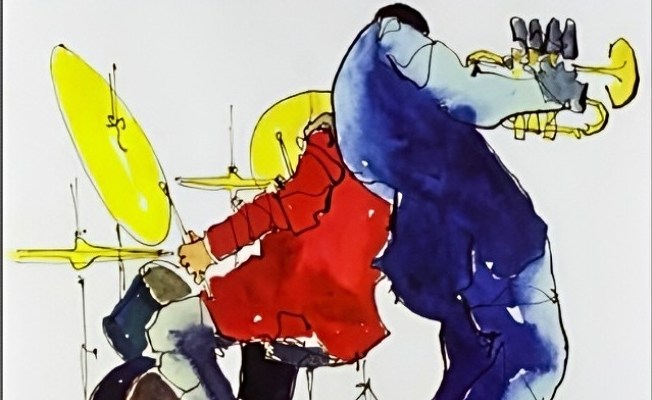
“A Child is Born”
Composed and arranged by Thad Jones.
Recorded by the Thad Jones-Mel Lewis Orchestra for Blue Note on May 25, 1970 in New York.
Thad Jones, flugelhorn, directing: Eugene “Snooky” Young, first trumpet; Al Porcino, Danny Moore and Marvin Stamm, trumpets; Eddie Bert, first trombone; Jimmy Knepper, Benny Powell, trombones; Cliff Heather, bass trombone; Jerome Richardson, first alto saxophone and flute; and Jerry Dodgion, alto saxophone and flute; Billy Harper, tenor saxophone and flute; Eddie Daniels, tenor saxophone and clarinet; Park Frederick “Pepper” Adams, baritone saxophone and clarinet; Roland Hanna, piano; Richard Davis, bass; Mel Lewis, drums/co-leader.
The story:
The history of big bands in the USA contains a number of stories about ensembles that were supposedly co-led by two different individuals. The variations and permutations on this theme are interesting. Unfortunately, history has shown that despite the best of intentions on the part of the co-leaders, these ventures usually end in rancorous dissolution. Here are a few examples.
There were a number of bands that were co-led by brothers. Probably the most famous of these ventures involved the Dorsey brothers, Tommy and Jimmy. Although the Dorsey brothers were apparent co-leaders of various ad hoc recording bands through the early 1930s, by the time they organized a standing, full-time band in 1934, it was clear that Tommy, because of his dynamic personality and immense drive (not to mention his great skill as a trombonist) was actually the leader of the band. Jimmy, who was the older of the brothers, and a great musician who had built-up a very solid professional reputation, was happy to let his dynamic younger brother do all the things he did to make their band better musically and commercially. However, as time passed, Jimmy began to resent the fact that because Tommy stood in front of the band and interacted very effectively with their audiences, the public was beginning to realize that Jimmy was not really the leader of the band in any discernable way. This gradually irritated Jimmy into taking various passive-aggressive actions designed to irritate Tommy.

The Dorsey Brothers Orchestra – December 1934. Tommy, with his trombone is in front, Jimmy is seated in the saxophone section to Tommy’s right. This modus operandi worked until it didn’t. Then Tommy left the band.
It didn’t take much to irritate Tommy. A virtuoso performer on his instrument and a musical perfectionist, Tommy was always wound very tightly. As he began to realize that his brother was growing increasingly resentful of his leadership of their band, he sensed correctly that he would never be able to truly lead the Dorsey Brothers Orchestra in a manner that satisfied him as long as Jimmy was in the band. He also correctly determined that he would be better able to realize his musical objectives as a bandleader by simply starting from scratch with his own band. This happened through the summer of 1935. By the autumn of that year, there were two Dorsey bands: Jimmy continued with what had been the Dorsey Brothers Orchestra, and Tommy took over an existing band, one that had been led with marginal success by Joe Haymes. Both brothers went on to great success with their separate bands for many years. They didn’t work together again until 1953. But that’s another story.
Another variation on the theme of co-leaders was to be found in the Bob Crosby band. Bob Crosby, Bing’s handsome and affable younger brother, was just a fair singer himself, but a very good front-man for the band he apparently led. He excelled in breezy patter with audiences and entertaining introductions of the songs the band played and of the many talented soloists in that band. But the actual musical and business leader of the band was Gil Rodin, a journeyman saxophonist in the band. Rodin’s astute leadership enabled the Bob Crosby band to achieve a good deal of success during the swing era. And that success served as a launching pad for many great musicians who played in the band for years, including: Yank Lawson, Billy Butterfield, Charlie Spivak (trumpets); Eddie Miller and Matty Matcock (clarinets and saxophones); Bob Zurke and Jess Stacy (piano); and Bob Haggart (bass and arranger). The division of duties between Crosby and Rodin worked well: the Crosby band operated with considerable success (1) from the mid-1930s until the many disruptions occasioned by World War II caused it to break up.

The Bob Crosby band in the mid-1930s. Bob is front and center, while the real leader of the band, Gil Rodin, stands to his left.
In the mid-1940s and well into the 1950s, yet another band was co-led by brothers, the Elgarts, Les who played trumpet, and Larry who played alto saxophone. For much of that time, Les, the older brother, led the band, though with ever-increasing and very valuable input from Larry. The band was initially billed as Les Elgart and His Orchestra. Gradually, Larry’s role as co-leader became larger. The band became known as Les and Larry Elgart and Their Orchestra, and had considerable success through much of the 1950s. In a remarkably similar way to the dissolution of the musical relationship of the Dorsey brothers, the Elgart brothers eventually went their separate ways as bandleaders. But in their case, it was Larry who was disenchanted and frustrated by the way Les was leading the band. He eventually broke away from Les in 1958 and formed his own band, which achieved considerable success. After this, Les continued to lead bands for some time.

Larry Elgart plays while Les listens.
The musical and business partnership between trumpeter Thad Jones and drummer Mel Lewis lasted longer than all of the above unions, from February 6, 1966, when the band they co-led first appeared at the Village Vanguard in Manhattan until January of 1979, when Jones left the band to move to Denmark to lead the Danish Radio Big Band. Their partnership was successful musically, less so financially. The two men basically got along, but there were rough spots along the way. Their parting was not handled well, as Jones simply left the band, leaving many commitments and other issues for Lewis to deal with. Mel was not happy about this, and spoke about it with bitterness. It seems that one sure way to make a partnership deteriorate and dissolve is to co-lead a big band.

Thad Jones and Mel Lewis, clad in dashikis, in happy times.
Nevertheless, before the ultimate dissolution of the musical relationship between Thad Jones and Mel Lewis, the band they co-led made a lot of good music, and fortunately, a good bit of that music was recorded.
The music:
The form of “A Child is Born” is that there are two sixteen bar sections that are almost identical, except there is a place in the second tract where a melodic variation goes a bit higher than in the first.

The Thad Jones-Mel Lewis Orchestra’s performance of Thad’s composition/arrangement, “A Child is Born,” begins without an introduction with pianist Roland Hanna playing the unadorned melody in waltz time, at first without any accompaniment. The tempo Thad set for this performance is reminiscent of the one Count Basie had set for his classic recording of “Li’l Darlin’,” which is to say very slow. Soon, bassist Richard Davis joins in, then Mel, with whispering brushwork on his snare drum. This opening sequence effectively sets the stage for what is to follow. (Roland Hanna is shown above right.)
Thad steps forward to play the melody on flugelhorn with great feeling, accompanied in quiet fashion only by Hanna, Davis and Lewis. Note how bassist Davis gradually provides more provocative counterlines on his acoustic bass. The flugelhorn had begun to be used more as an auxiliary horn by jazz trumpeters through the 1960s as an instrument that generally provided a softer, more velvety sound than the trumpet.

When the band appears, it is with the utmost subtlety: unison flutes, open fluffy trombones and Harmon-muted trumpets. The trumpets soon go tacit, then return, briefly playing softly with plunger mutes, then open and building dynamically. The climax in this performance is suffused with warmth: the flutes play the melody, the open trombones provide harmonic pads, and finally the open trumpets, led majestically by Snooky Young. Mr. Young, one of the greatest lead trumpeters to emerge from the swing era, provides an object lesson here about playing in ever higher registers without blasting. (Above left: Snooky Young with a trumpet and Thad Jones with a flugelhorn – mid-1960s.)
The ensemble sounds then subside as the flutes gently reprise the melody, underlined by arco (bowed) bass and a brushed cymbal.
The recording presented with this post was digitally remastered by Mike Zirpolo.
Notes and links:
(1) Another reason why the Bob Crosby band operated successfully is that it was a cooperative band, with band members actually owning percentages of the band’s business operation.
Here are some other great performances by the Thad Jones-Mel Lewis Orchestra, the first a barn-burner, the second a lovely ballad.