As Tuesday’s deadline approached, the president accepted a proposal from Pakistan to temporarily pause hostilities and reopen the Strait of Hormuz while negotiators work to end the war.
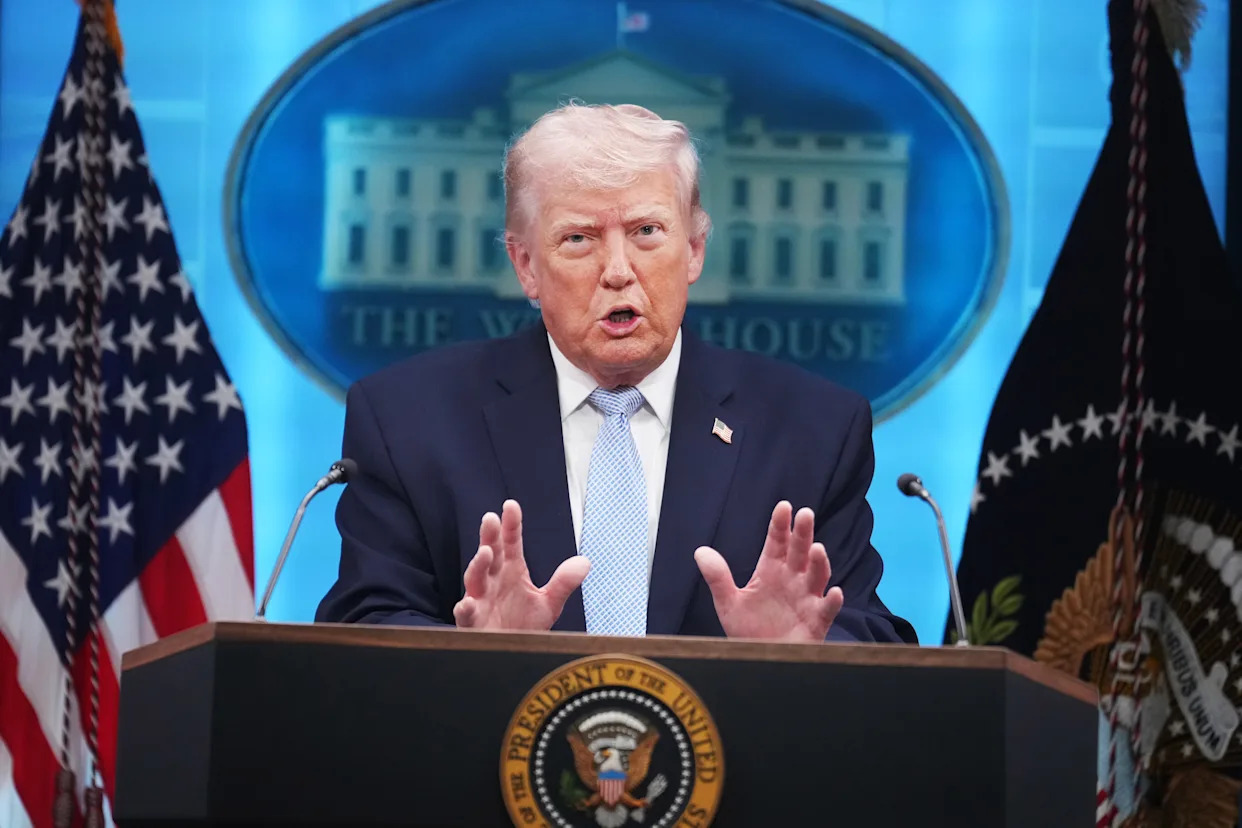
President Trump announced on social media late Tuesday that he had accepted a two-week ceasefire with Iran just hours before his threatened deadline for launching crippling attacks on the country’s civilian infrastructure.
“The reason for doing so is that we have already met and exceeded all Military objectives, and are very far along with a definitive Agreement concerning Longterm PEACE with Iran, and PEACE in the Middle East,” Trump wrote. “We received a 10 point proposal from Iran, and believe it is a workable basis on which to negotiate.”
Iran’s foreign minister confirmed in a statement that the Iranians would “cease their defensive operation” and that “for a period of two weeks, safe passage through the Strait of Hormuz will be possible.”
Earlier in the day, Trump warned Iran that its “whole civilization will die tonight” if leaders in Tehran don’t strike a deal to cease hostilities and reopen the Strait of Hormuz by 8 p.m. ET on Tuesday evening — a rhetorical escalation that reflected the president’s eagerness to end a war that has engulfed the Middle East for more than five weeks.
For much of the day, it was unclear whether Trump — who has backed down from several ultimatums over the last month — would follow through.
“A whole civilization will die tonight, never to be brought back again. I don’t want that to happen, but it probably will,” the president wrote on Tuesday morning. “We will find out tonight, one of the most important moments in the long and complex history of the World.”
Trump added that he hoped “different, smarter, and less radicalized minds” within the regime would “prevail” and that “maybe something revolutionarily wonderful” would happen instead.
In a statement on social media, the prime minister of Pakistan urged Trump to extend his Tuesday night deadline by another two weeks “to allow diplomacy to run its course.” During that time, the Strait of Hormuz would reopen and a ceasefire would be observed. Reports then suggested that Iran might accept the proposal; White House press secretary Karoline Leavitt said in a statement that Trump had “been made aware of the proposal, and a response will come.”
The president also told Fox News in a phone interview that the U.S. was “in heated negotiations” and called Pakistan’s prime minister a “highly respected man.”
In announcing the ceasefire, Trump said that it was “subject to the Islamic Republic of Iran agreeing to the COMPLETE, IMMEDIATE, and SAFE OPENING of the Strait of Hormuz” for two weeks — a period that would “allow the [current] Agreement to be finalized and consummated.”
Prior to Trump’s announcement, both the U.S. and Israel had been trying to force Iran’s hand by ramping up their attacks. Early Tuesday, the U.S. launched more than 90 strikes on Kharg Island, Iran’s main hub for oil exports.
In response, the Iranian military vowed that Iran would “deprive the U.S. and its allies of the region’s oil and gas for years” and expand its own missile and drone barrages across the region if Trump devastates Iran’s infrastructure.
Here’s how we got to this moment, and what could happen next.
A timeline of Trump’s ultimatums
Trump has been vowing for more than two weeks that Iran will suffer devastating strikes on critical energy infrastructure unless it lifts its effective blockade of the Strait of Hormuz, a critical oil and gas shipping route in the Persian Gulf.
With global supply severely constrained, benchmark oil prices have jumped more than 50% since late February — from about $71 per barrel before the first wave of attacks on Iran to about $110 per barrel today.
March 21: Trump threatened to “hit and obliterate” Iran’s power plants within 48 hours unless the Islamic Republic agreed to fully reopen the strait.
March 23: Roughly 12 hours before his deadline, Trump wrote on social media that he had delayed his strikes on Iranian energy infrastructure for five days, claiming that the U.S. and Tehran had launched “VERY GOOD AND PRODUCTIVE CONVERSATIONS REGARDING A COMPLETE AND TOTAL RESOLUTION OF OUR HOSTILITIES IN THE MIDDLE EAST.” While Trump spent the next few days insisting that talks were going well, Tehran publicly denied that talks were occurring at all.
March 26: Shortly after Wall Street stocks plummeted, the president again postponed his deadline by 10 days, this time to April 6 at 8 p.m. ET. He said he was “pausing the period of Energy Plant destruction” at the request of the Iranian government. Over the next week and a half, Trump vacillated between predicting an imminent deal and issuing increasingly heated threats.
March 30: Trump wrote on social media that a deal would probably be “shortly reached — but if not, the U.S. would “conclude our lovely ‘stay’ in Iran by blowing up and completely obliterating all of their Electric Generating Plants, Oil Wells and Kharg Island (and possibly all desalinization plants!).”
April 1: Trump claimed that Iran had requested a ceasefire — a claim that Iran’s foreign minister dismissed as “false and baseless.” Trump said the U.S. would only consider a ceasefire when the Strait of Hormuz was “open, free and clear,” adding that “until then, we are blasting Iran into oblivion or, as they say, back to the Stone Ages!!!”
April 4: As his postponed April 6 deadline approached, Trump warned Iran that “time is running out — 48 hours before all Hell will reign down.”
April 5: Once again, Trump pushed back his deadline — this time from 8 p.m. ET on April 6 to 8 p.m ET on April 7. “Tuesday will be Power Plant Day, and Bridge Day, all wrapped up in one, in Iran,” he wrote on social media on Easter Sunday. “There will be nothing like it!!! Open the F***in’ Strait, you crazy bastards, or you’ll be living in Hell.”
What the U.S. is asking for
The New York Times reported on March 24 that the U.S. had sent Iran a 15-point plan to end the war, citing “two officials briefed on the diplomacy.” The officials said the plan, which reportedly addressed maritime routes as well as Iran’s nuclear program and ballistic missiles, had been delivered by Pakistan.
The Associated Press reported that the U.S. plan called for a 45-day ceasefire and reopening the Strait of Hormuz.
The Iranian regime publicly rejected the U.S. plan, calling it “unrealistic” — but privately signaled some willingness to attend talks hosted in Pakistan’s capital, Islamabad, according to reports.
Since then, Trump has cast doubt on his terms for ending the war.
The Wall Street Journal reported on March 31 that the president had “told aides he’s willing to end the U.S. military campaign against Iran even if the Strait of Hormuz remains largely closed” because they had “assessed that a mission to pry open the chokepoint would push the conflict beyond his timeline of four to six weeks.”
Meanwhile, Trump told Reuters on April 1 that he is no longer bothered by Iran’s stockpile of enriched uranium — one of his main rationales for attacking Iran in the first place. “That’s so far underground, I don’t care about that,” he said.
What Iran is asking for
On Monday, April 6 — the day before Trump’s latest deadline — Tehran put forward its own 10-point plan to end the war, according to reports from Iranian state media. Details of the plan were not immediately clear, but two senior Iranian officials told the New York Times that it includes “a guarantee that Iran would not be attacked again, an end to Israeli strikes against Hezbollah in Lebanon and the lifting of all sanctions.”
Iranian state media said the proposal “rejected a cease-fire” and “emphasized the necessity of a permanent end to the war in line with Iran’s considerations.”
In exchange, Iran would lift its blockade of the Strait of Hormuz — but also assert new control over transit there, imposing a fee of $2 million per ship that it would split with Oman and use to rebuild infrastructure destroyed by U.S. and Israeli attacks.
Asked on Tuesday about Iran’s proposal, Trump said it was “a significant step,” but “not good enough.”
A day earlier, he said “part of [the] deal is going to be we want free traffic of oil and everything else,” suggesting that Iran’s proposed fee could be a sticking point.
Reported details of Iran’s 10-point plan — described by Trump on Tuesday evening as “a workable basis on which to negotiate” — did not include any concessions on uranium enrichment.
What happens next
Multiple outlets, including the New York Times and the Wall Street Journal, reported on Tuesday that Iran had cut off direct communication with the U.S. and walked away from negotiations due to Trump’s latest threats.
“The power of a ‘CIVILIZED’ nation’s culture, logic, and faith in its righteous cause will undoubtedly prevail over the logic of brute force,” a spokesman for Iran’s foreign ministry wrote on social media on Tuesday.
But Axios reported on Tuesday afternoon that “progress has been made in the past 24 hours” — though potentially not enough to reach a ceasefire deal before Trump’s 8 p.m. deadline.
Acknowledging Iran’s 10-point plan — “a lot better than we expected,” according to one U.S. official — Axios reported that “the thinking in the White House has shifted from ‘can we get there?’ to ‘can we get there by 8 o’clock tonight?’”
“The main option under discussion is a set of confidence-building measures by both Iran and the U.S. focused on reopening the Strait of Hormuz and in exchange for guarantees on ending the war,” Axios added.
At a press conference in Budapest on Tuesday, Vice President JD Vance said “the ball is in Iran’s court.”
“We feel confident we can get a response from the Iranians by 8 p.m.,” Vance said. “We hope it is the right response.”
After Trump’s ceasefire announcement, the New York Times reported that it had come after “frantic diplomatic efforts by Pakistan and last-minute intervention by China, a key ally, asking Iran to show flexibility and defuse tensions.” The Times also reported that the ceasefire was approved by Iran’s new supreme leader, Mojtaba Khamenei.
Trump predicted on Monday that his threatened infrastructure strikes would mean “every power plant in Iran will be out of business, burning, exploding and never to be used again.”
“It will take them 100 years to rebuild,” he said.
Experts on international law say that destroying power plants, desalination stations, oil wells, roads, bridges and other infrastructure would be considered war crimes in most cases because of the suffering such acts would inflict on Iran’s 93 million civilians.
Iran’s U.N. representative said on Tuesday that Trump’s threats “constitute incitement to war crimes and potentially genocide,” adding that Iran would “take immediate and proportionate reciprocal measures” if the U.S. follows through.
On Tuesday, some Iranians formed human chains along bridges and around power plants, according to videos and photographs posted by state and other local media. At least one Iranian official urged such action ahead of possible U.S. strikes.
Andrew Romano, Reporter